
Dr Amos Yong is a professor of theology and mission at Fuller Theological Seminary. Since joining Fuller in 2014, he has held several leadership roles, including dean of both the former School of Intercultural Studies and the former School of Theology, and chief academic officer for the 2020-2021 academic year.
Dr Amos is the author or editor of over 60 books and more than 275 scholarly articles. His research focuses on Pentecostal theology, Christian-Buddhist dialogue, the theology of disability, and the mission of God. His most notable works include Renewing the Church by the Spirit: Theological Education after Pentecost (2020) and Can “White” People Be Saved?: Triangulating Race, Theology, and Mission (2018). Last year he released Trauma and Renewal: Toward a Spiritual Communal and Holistic Transformation (Orbis Books, 2025), a collaborative work with his wife Alma and son Aizaiah, who serves as the primary author.
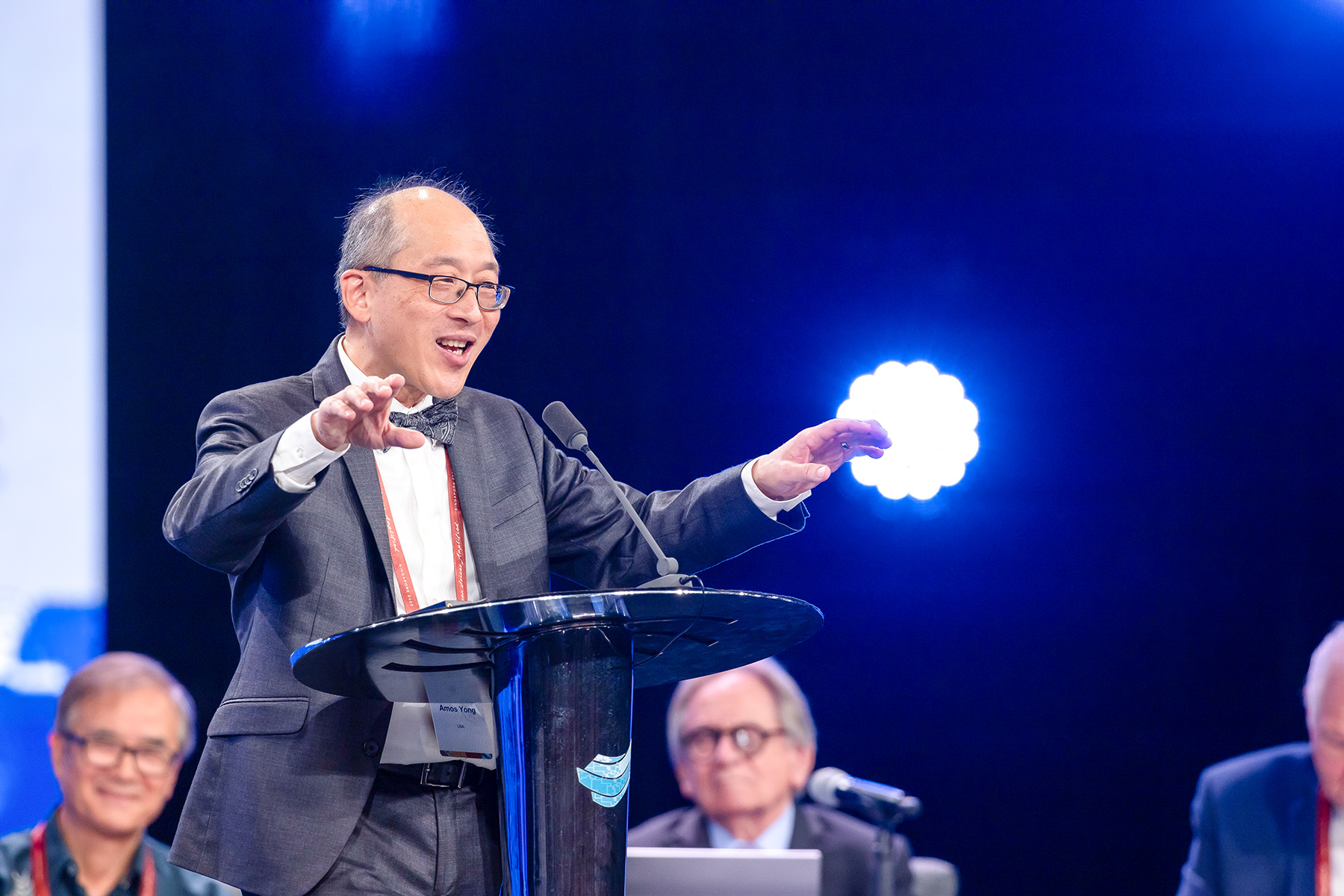
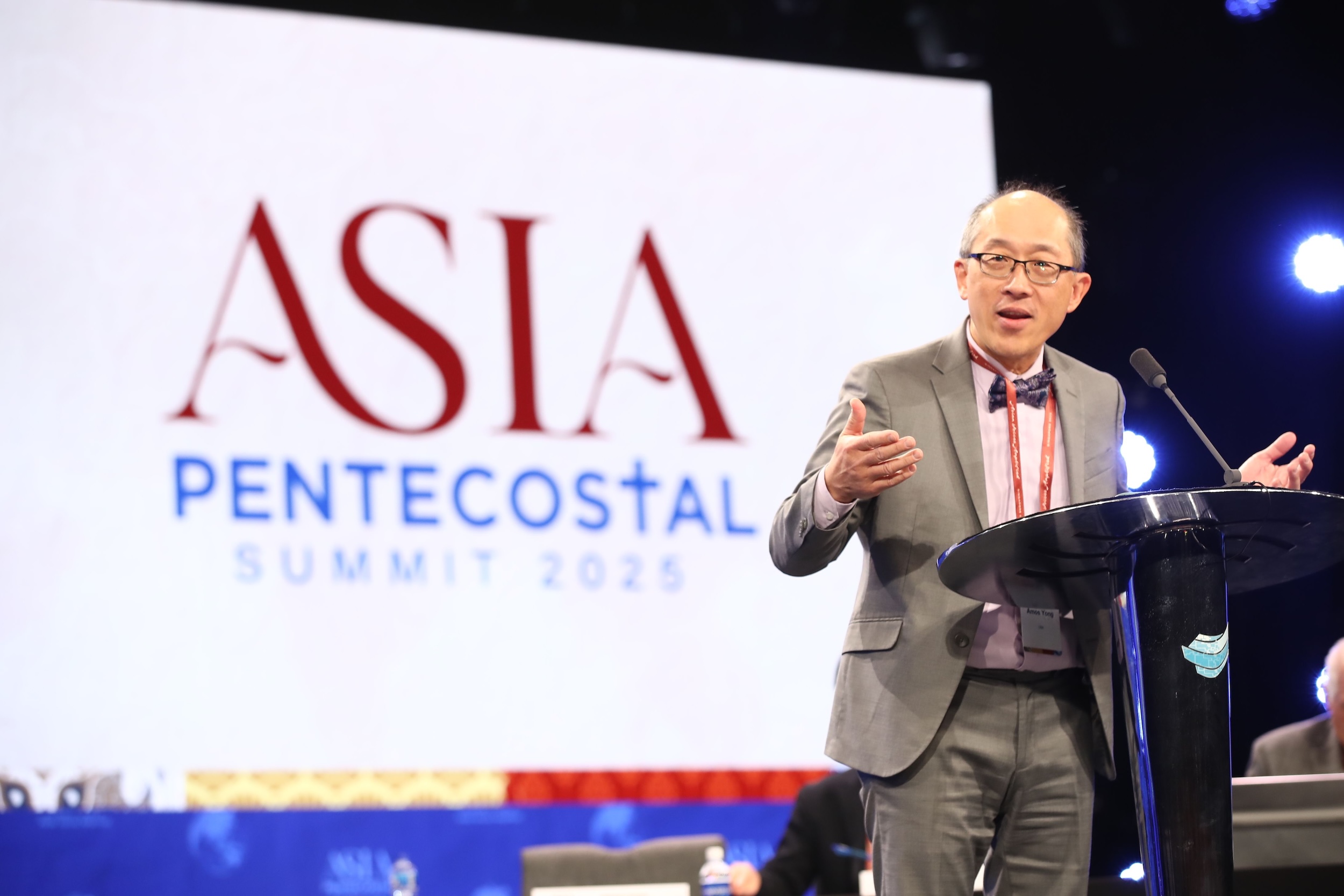
Dr Amos presented his paper “Many Tongues, Many Professions: Toward a Pentecostal Theology of Vocation at APS 2025.
CITY NEWS: Before we speak about your work and writings, Prof Amos, we would love to hear your salvation story.
PROF AMOS YONG: I was born into a Christian home. My parents were pastors in the Assemblies of God, so in that respect, I grew up as a pastor’s kid.
In terms of my salvation story, I would say my recollection is that I was saved many, many times. From a very young age, I responded to many altar calls. I remember multiple occasions when I was asked if I wanted to give my heart to Jesus, and I would respond.
 At that time, my parents were pastors in Taiping, Malaysia. When I was 10 years old, they took me and my younger brother to the United States. One of the Assemblies of God missionaries from the US had come to Malaysia. She was a single white woman who always had a heart for Chinese people. Through her missionary ministry in West Malaysia, many families came to Christ.
After 1965, an Immigration Act was passed by Congress in North America that allowed immigration from Asia. As a result, many Chinese-speaking people immigrated to different parts of North America, including Northern California. This American missionary was from Northern California, and when she returned there, she saw the growing number of Chinese immigrants. Because she had a call to reach Chinese-speaking people, she established churches in six or seven cities in Northern California where there were Chinese immigrant communities. She then began looking for pastors for these churches.
My parents were among a handful of Malaysian Chinese pastors whom she sponsored and brought to Northern California to minister among the Chinese people there. So through that ministry opportunity, I became a missionary kid at that time.
My parents were both first-generation Christian converts. At home, they spoke English with their children, so growing up, I mainly spoke Cantonese only with my grandmother. When we moved to Northern California, my recollection is that my parents’ ministry was bilingual. The churches ministered to Chinese-speaking immigrants, but many of us children who were growing up there were more comfortable in English. So the ministry had to serve both generations—the Chinese-speaking adults, as well as the younger ones like us who were primarily English speakers.
Take us back to your first encounter with the Holy Spirit. What was that experience like, and how did you receive the baptism of the Holy Spirit?
My first experience of Spirit baptism was probably when I was 11 or 12, after moving to the US. We had a handful of churches for Chinese-speaking immigrants, and every summer, they would hold an annual church camp that included both Chinese-speaking and English-speaking services.
Probably during my first or second summer there—and then in a variety of summers after that—I experienced Spirit baptism and speaking in tongues in the context of those camp meetings.
You are known as one of the most prolific and widely cited scholars in your field. Many of us would be curious to know: what does your writing process look like, and how long does it usually take you to complete a book?
The shortest period it has taken me to write a book was about six weeks. In the summer of 2017, I wrote a short book, Learning Theology. But that was after almost 20 years of writing.
For many of my books, there is usually a long process of initial research, thinking through the topic, drafting, and so on. If I am working on a new topic that requires fresh research, it is not uncommon for the process to take a couple of years—sometimes even three years.
Some of the books I have published include material I have collected over many years, so in that sense, those books have taken a long time to come together. It really depends on the kind of book, the topic, and how the book developed.
You have written so many books and articles over the years. For someone who is just beginning to read your work, which of your writings would you most encourage people to read, and why?
From a City Harvest perspective, I think my book Who Is the Holy Spirit? A Walk with the Apostles is a good place to start. It looks particularly at the book of Acts and attempts to understand the work of the Holy Spirit in dialogue with the apostles and their experience. The book explores how the Holy Spirit is manifested throughout Acts, even in places where the Spirit is not explicitly mentioned.
For many City Harvesters—whether ministers, those doing their certificate in theology, or students in the bachelor’s or master’s programmes—I would also recommend my book Learning Theology, which I referenced earlier. It is an attempt to invite beginning theological students to embrace the study of theology as part of what it means to be a disciple.
You have written about Internal Family Systems, or IFS, from a theological perspective. What led you to that topic, and how did you begin to see the connection between IFS and theology?
My son, Azaiah, is a practical theologian. He finished his PhD around 2019 or 2020, and part of his course of study included exposure to IFS—Internal Family Systems. Since then, he has gone through the various levels of IFS certification. I think there are three levels, and he may have completed the final level around 2022 or 2023. He has a full-time job—probably more than one full-time job—so he does not practise IFS in a full-time capacity. But as opportunities arise, he does provide some IFS training as a certified practitioner.
For him, his interest in IFS was deepened through his own personal journey. He was involved in a motorcycle accident, and working through the trauma of that experience deepened his interest in, and eventually his commitment to, pursuing the different levels of IFS certification.
His journey is also shaped by the fact that he is multiracial. My wife is Mexican American, and I am Chinese American, so he and his two sisters grew up as multiracial persons. He began to see the relevance of Internal Family Systems not only in his recovery from the trauma of the motorcycle accident, but also in his journey as a multiracial person.
His PhD research was on multiracial spirituality—the spirituality and religiosity of multiracial persons in the United States. He was asking: What does it mean to be multiracial? How does multiracial spirituality play itself out, especially in a society where race is constructed in particular ways? Every society is racialised differently. There are dominant cultures and minority cultures, and minority cultures have to navigate the realities of the majority culture. For instance, South Asians and Filipinos in Singapore may have to navigate a predominantly Chinese reality. In the United States, multiracial people have to navigate dominant cultural perspectives, values, and expectations. The Black-white binary is the dominant racial construct there, and other minoritised identities—such as Chinese Americans, or in his case, multiracial persons—have to find their place within that framework.
So much of his growing appreciation for IFS had to do with processing racial trauma, racialised trauma, and minoritised cultural trauma in majority white societies. How do we work through the opportunities and challenges of our spirituality when we have to deal with both microaggressions and macroaggressions as minoritised people in white-dominant societies?
As he grew in his own understanding of these issues, and as IFS gave him certain tools to engage them, he began inviting me to consider these questions too. At first, I was a bit sceptical. I was not sure I wanted my son doing therapy on his father! But by that time, I was also becoming more aware of my own journey as an Asian American. I had finished my PhD without really asking questions about my own racialisation or minority position within a white-dominant culture. For many Chinese in white-dominant Western societies, the tendency is not to press into the Black-white binary, but to let that conversation happen elsewhere. Yet that often means we assimilate into majority white cultural norms. In that sense, we internalise whiteness in our own positionality.
By the time my son began his PhD, I knew enough to recognise that this had been my reality. The question then became: What do I do with that? His own journey of confronting and navigating these questions brought them to the surface for me as well. At first, I was reluctant, but over time, I began to engage him more intentionally, especially after his accident. A few years after the accident, he asked me, “Would you like to write a book with me about what happened through my accident?” So we had many conversations about trauma—how to think about trauma, how Christians respond to trauma, and how to think about trauma theologically. We are both theologians, so these were important conversations for us.
Eventually, he published a book called Trauma and Renewal. My wife and I contributed a few sections to the book. Initially, we had thought we might write it together, but as the process unfolded, we decided that he would write the book, with contributions from us.
God willing, I hope that the next book I write will be on trauma, from a father’s perspective. It would explore what it means to work through trauma and trauma theology, first in relation to the accident my son suffered, and then more broadly. I also want to think about this as a Chinese American, and consider how the Confucian, Taoist, and Buddhist aspects of my own identity and journey might be thought about theologically in relation to God.
All that to say, along the way, my son kept telling me, “Your many tongues motif, your many tongues thesis—that relates to Internal Family Systems.” I kept saying to him, “Well, why don’t you write a paper about it, son? Give me a chance to read it, and I’ll give you some feedback.” But he kept pressing and saying, “No, I think we need to write this together.” So there you go.
For the wider congregation who may not have heard your presentation: Harmonising the Many Tongues Within: A Pentecost study of Internal Family Systems at APS 2025, how would you explain the heart of your paper in a simple and accessible way? What do you hope they would understand from it?
My short version would probably go something like this: I think most of us have a sense that there are different “parts” within us. We might say, quite casually, “One part of me wants to do this, but another part of me is thinking about that.” We say things like that almost nonchalantly. What IFS does is help us name these different parts. It gives us more language to articulate what these parts might be, and how they show up in different contexts.
Many of us wrestle with the different ways our self emerges and expresses itself in different situations. Sometimes we show up in positive ways; at other times, we show up in ways we may not want to, or may later regret. IFS helps us name both—the constructive ways we respond, as well as the more negative ways we respond.
 For instance, many of us recognise moments when we react in anger, shame, or regret. We may think, “I don’t want to feel shame,” or “I don’t want to be angry.” But anger can play a positive role in our lives, and shame can sometimes alert us to something deeper within ourselves. If we never felt shame or anger at all, there would be something less than fully human about that. The issue is that we often do not have good ways to think and talk about these experiences. IFS gives us a way to reflect on shame, anger, and other emotions—not so that we let them run wild, but so that we can understand what they are trying to communicate.
In that sense, IFS may give us new ways to appreciate these feelings more constructively. It helps us see what they reveal about who we are, in all our complexity and with all our different parts.
That makes sense. But some people may feel, “I would rather not know what is really going on inside me.” What would you say to someone who is afraid to look more deeply?
That is part of the journey. There is a sense in which our not wanting to know may be because it feels too painful. And that itself may be an indication that we need help—not necessarily IFS specifically, but perhaps Christian counselling, or at least a willingness to open ourselves up to the possibility of taking steps in that direction. The journey begins when we are willing to acknowledge that there may be something deeper going on, and that we may need support as we begin to face it.
In light of what you have just said, how does the Holy Spirit come into this? If our lived experiences can become a theological resource, how does the Spirit help us understand, process, and respond to them?
I shared the story of how my son kept wanting me to think about IFS. He is a verbal processor, and I do not think he was necessarily trying to “do therapy” on his dad. But as a theologian himself, as he was learning these new theological ideas, he would process them with me—his father, who is also a theologian. So as he was learning about IFS, he was processing those ideas with me.
When he first began asking me personally about some of these IFS-related concepts and questions, my initial reaction was to be defensive, or at least guarded. Why? Because I was not necessarily sure I wanted to begin looking within myself and acknowledge that there were these parts of me. He was not trying to put his finger on anything directly. He was simply asking questions. But I found myself guarded. That process led me to see something about myself. Writing books requires a huge investment of time and energy. In my case, there was a certain Confucian work ethic mapped onto a Puritan work ethic, mapped onto an immigrant experience of needing to prove that this Chinese Malaysian experience had value in white-dominant societies. That meant needing to achieve a certain level of acceptability and respectability. So I worked hard. But sometimes there is a fine line between working hard and working too hard, or even becoming a workaholic. That drive enabled me to operate at a certain theological level, but it did not necessarily include the capacity to be introspective.
So, to answer your question about how the Holy Spirit works, I think in my case, the journey involved the Holy Spirit slowly, gently, and through repeated conversations with my son, bringing me to a realisation. Even as his father, over the decades, I had been very guarded. I had not even been fully transparent with myself about some of these things. Only slowly, and over time—and I am still on this journey—I am processing what it means to be more honest with myself about who I am and why I do what I do. What has been healthy about that? What has been unhealthy? Am I willing to make changes at my age? What would those changes entail? All of that has come from being willing to take baby steps, have these conversations, and begin naming those parts of myself that have made me very productive. In IFS language, those “managers” keep us moving forward, often so that we can avoid certain things or avoid confronting the “exiles” in our lives.
Your second paper, Many Tongues, Many Professions: Toward a Pentecostal Theology of Vocation, was fascinating. Many Christians are familiar with ideas like business as mission, the holiness of work, or work as a return to the Garden. But what you shared felt quite different. What inspired this paper, and how would you summarise its main idea for the general reader?
The idea for this paper came out of my long-standing thinking about Acts 2. The backstory is that I did my PhD in the mid-1990s, and I was probably among the first handful of Pentecostals who were able to do PhDs in theology on Pentecostal topics. Even in the mid-1990s, that was almost an oxymoron. Pentecostals and theology were not always understood together in that way.
But I came along at the right time. I was given opportunities, and I worked with mentors and others who welcomed and encouraged me in this work. Early on, it began to dawn on me that the book of Acts, which is the central narrative for Pentecostal experience, invites ongoing theological reflection. I started with the book of Acts in my PhD studies, and in some respects, I have never left it. I have continued thinking about the Acts 2 narrative and everything that follows from it. My book, Who Is the Holy Spirit?, basically follows the book of Acts from chapter one all the way to the end.
Over the last 10 to 15 years, I have begun to think more deeply about how the many tongues of Pentecost provide not only metaphorical, but also theological, resources for thinking about many different things. Even the conversation around Internal Family Systems had to do with “many tongues within,” and how Acts 2 might invite us to think about that.
In the case of this paper on vocation, it came from recent work I had been doing on translation and mother tongue. I began to notice how often our own languages appear in our stories. Our mother tongue is our first language, and that helped me think about how our first words can also be seen as part of the initial flowering of the Spirit’s gifts in our lives.
When we tell our stories, we bear witness to the journey we have been on. That journey is rooted in our childhood, our family, our education, our work, our struggles, and the opportunities that shaped us. The way we tell that story, in our own language, reveals some of the most intimate parts of who we are. I began to see the mother tongue as a window into the Spirit giving utterance to the deepest parts of our lives. And those intimate parts inevitably shape the public parts of who we are.
For example, only you can tell the story of how you became who you are today—how your personal journey eventually found public expression in your vocation. On some occasions, you might tell that story in a more contained way: you studied, got a job, received opportunities, and God opened doors. But if given the opportunity, you could probably connect the dots between something that happened in your childhood, or in school, or in your family, and how that opened the door to the next step.
My point is that the mother tongue, the interior parts of the journey, and the most intimate aspects of our lives eventually find public expression in our vocation. They are not disconnected, even if we do not always have the language to make those connections. I think Spirit empowerment and Spirit baptism help us make those connections. The power of testimony becomes deeper when those connections remain intact.
You define “profession” not only as what we confess, but also as what we do. So for someone who says, “I’m not sure what my vocation is,” how would you encourage them to begin discovering it?
On the one hand, I would say that our vocation is our calling as Christians. Our first calling is to be disciples—followers of Jesus. That is always the overarching vocation. On the other hand, that vocation can take many forms and expressions. Sometimes we speak of people as being bi-vocational, such as pastors who are also tentmakers. But if we think about it, being a pastor or a tentmaker is still secondary to the primary vocation of being a disciple of Jesus. In that sense, we are all multi-vocational in some way.
I use the word “vocation” to refer to these broader callings. I use the word “profession” to refer more specifically to the jobs we have within those callings. Sometimes a particular vocation may include multiple professions. For example, I profess as a faculty member, and I also profess as an administrator. These are related, but they are different jobs. Yet both are part of my vocation as a theological educator. Before I became a theological educator, my vocation was as a civil servant. I worked for the state government for about 10 years. Within that vocation, I held two different jobs at different times. One job was to give out financial and food assistance to people in need. Another was to collect child support from absent parents. They were two different jobs, but both were part of my vocation at that time as a civil servant. My overarching vocation, however, was still as a follower of Jesus. My secondary vocation was as a civil servant, and within that secondary vocation, I had multiple jobs successively.
In the medieval period, it was probably more common for a person to have one vocation or one life station over many years. The idea of changing jobs is much more modern, especially in industrial societies. Today, many people may have multiple jobs, sometimes even at the same time. But my point is that all of this is connected to our “mother tongue”—the initial rootedness and groundedness of who we are. When that is caught up by the Holy Spirit, it is then oriented toward being followers and disciples of Jesus for the kingdom of God.
Pentecostal theology is relatively young compared with traditions such as Methodism or Presbyterianism, yet the Pentecostal-charismatic movement now cuts across many denominations. Why is Pentecostal theology important today, and how can Pentecostals and charismatics from different traditions come together?
It is important for Pentecostals and charismatics to come together, not necessarily so that we all arrive at one common agreement, but so that we can grow in understanding together. There is so much happening in our churches, and many of them are growing. But growth is not always simple. The more people we have, the more issues we have, because people are people. Sin is still in the world, and every community has its challenges.
That is both the opportunity and the challenge the Holy Spirit is giving us. If our numbers are growing, then all the more we need theology to help us deal with, respond to, and engage the opportunities and challenges that come with growth. With greater blessing comes greater responsibility.
This also applies to our charismatic brothers and sisters, and even to brothers and sisters in other traditions, including the Catholic and Orthodox communions. As Pentecostal theology continues to grow, we should engage these other voices. We grow theologically not by staying on our own island, but through dialogue, relationships, friendships, challenges, oppositions, and even the dissonance that comes from encountering those who are different from us.
We also need voices from outside theology. As Heidi Campbell mentioned, non-theological disciplines can bring both agreement and dissonance into the conversation, and that can help us grow.
So I do not think the goal is always agreement. Growth often happens when we are challenged by difference. Sometimes we need to stay with the discomfort of that difference long enough for real growth to take place. If we all simply agree with one another, then there is very little to challenge us.
That is why ongoing accompaniment—staying with one another even amid our differences—is part of both the opportunity and the challenge of our theological journey.
Maybe for some people, that seems like a lack of unity. How would you respond to that?
You’re right. From that perspective, the question becomes: how do we learn to love one another without necessarily all speaking the same language? Jesus said that the world will know we are His disciples by our love for one another. So how do we love one another through differences in language, culture, and even belief?
Another way to put it is that different churches have different charisms, different gifts, and different testimonies. They bear witness to God’s work in different ways. The question is: how can we learn from the gifts, charisms, testimonies, and witnesses of others, even when they are not exactly the same as ours?
You spoke about what it means to live a Spirit-led life. Was there ever a time when the Holy Spirit led you somewhere you were reluctant to go, but later realised was part of God’s work in your life?
Yes. In fact, this is an area I have worked on for some time—the question of religious “otherness,” or how Christians think about people of other faiths. That has always been a challenge. There can be a lot of fear, anxiety, strangeness, and instinctive reactions. As Christians, our instinct is often to want to convert people. And yes, we should bear witness—but it is the Holy Spirit who converts.
One of the most challenging aspects of engaging people of other faiths is that the Holy Spirit also continues to invite our conversion—our ongoing conversion to Jesus. Paul says, “I die daily.” Our conversion to Jesus is never complete.
I think many of us, myself included, can feel uneasy about what that means in our relationships with people of other faiths. It is easy to say, “We want to invite you to convert to Jesus.” But what does it mean for me to die daily in the presence of people of other faiths?
That is a question many of us may not want to ask, because we are often too busy trying to evangelise.
This remains very difficult to talk about. Sometimes I do worry about our ability to think theologically and carefully about these things.
