
He is widely recognised for his work on cultural background studies, miracles, and commentaries on several New Testament books, including Matthew, Romans, 1 and 2 Corinthians, Galatians, 1 Peter, Revelation, John, and Acts. He is currently working on a multi-volume commentary on the Gospel of Mark.
Dr Craig presented two papers at the Asia Pentecostal Summit 2025: “Paul Supported the Ministry of Women” and “Paul Taught Mutual Submission”. He tells City News the importance of understanding the context of the books of the Bible, and tells us about his personal faith journey.
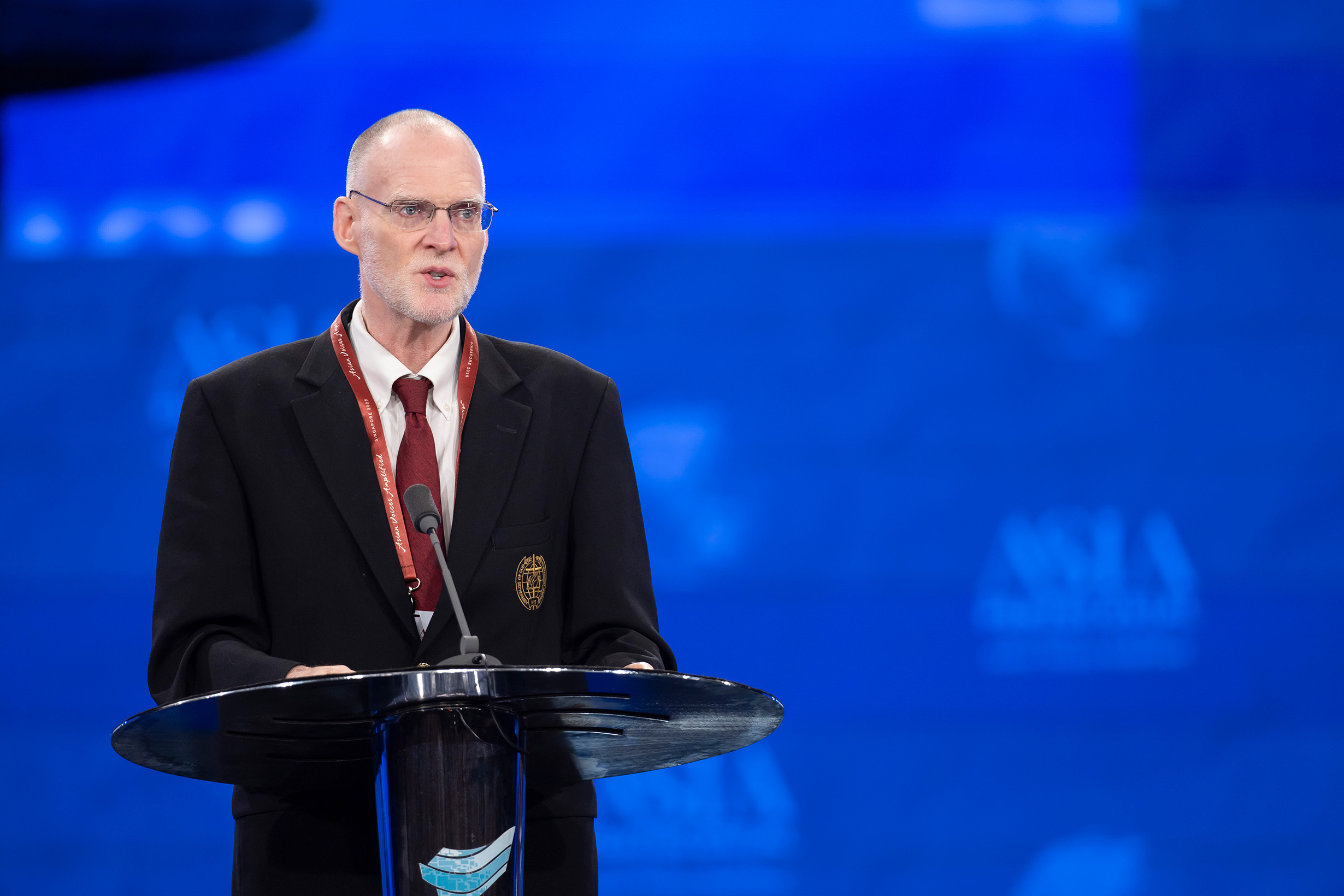 CITY NEWS: You were asked to speak on two specific topics. If you had a choice, what topic would you have chosen instead?
DR CRAIG KEENER: In places with strong secular influence where there are many people who don’t believe the Bible, like much of the US, I often speak on the reliability of the Gospels, and the reality of miracles. I probably wouldn’t have thought those were necessary topics here, and in fact, I get asked to speak on miracles too much. Generally, I love to speak on anything in God’s Word. My ideal format is a room full of people asking questions—with someone curating them—and going at it from the Bible as much as possible.
Could you share your personal story with God? How did you come to Christ, and how did you encounter the Holy Spirit?
I grew up in a family that didn’t go to church and didn’t talk about religion. My mom was an agnostic, but I only found that out after I became a Christian. I was an atheist and even made fun of Christians. I was one of the mean atheists. But at some point, I began to worry about the stakes if I was wrong. And I started praying, “God, if you’re out there, please show me.”
One day, some fundamentalist preachers stopped me on the street and shared that Jesus died for me and rose again, and that I could have eternal life through Him. I argued for about 45 minutes, bringing up things like dinosaurs. They gave a very poor answer about the devil putting dinosaur bones there, which I knew was absurd. But as I walked away, I became deeply convicted by the Holy Spirit.
At home, I was overwhelmed by God’s presence. I prayed, essentially, “God, I don’t understand how Jesus dying and rising makes me right with You, but if that’s what You’re saying, I’ll believe it. I don’t know how to be made right with You, so if You want to do it, You have to do it Yourself.”
I then felt something rush through my body. I jumped up, scared, wondering if God came inside me or something strange had happened.
I had always thought if I ever discovered God was real, I would give Him everything, because if He made me, then I belonged to Him. I found a New Testament and started reading. This happened on Friday, October 31, 1975 –exactly 50 years ago from the day of this interview!
Two days later, which was Sunday, I walked into a nearby church where the pastor had previously shown me kindness, giving me rides to school in the rain. That night, the pastor asked if I was sure I was saved. I said I wasn’t sure I’d done it right, so he led me in a prayer, similar to what I had prayed at home.
Again, I felt an overwhelming sense of God’s presence, but this time without fear. I began to praise God, realising I couldn’t praise Him adequately unless He gave me the words. Suddenly, other languages began coming out of my mouth, though I had never heard of it before. That went on for about an hour or two, with a joy beyond anything I had experienced. Life, which had felt purposeless as an atheist, finally made sense.
I knew nothing about the Bible compared to little kids in Sunday school, so I began “cramming” the way you would for school. For a time, I read around 40 chapters a day, sometimes reading the New Testament in a week. Eventually, I became so familiar with it that when someone quoted a verse, I usually knew about where it was in the flow of the text. Out of that, I also started witnessing to others on the street, just as people had witnessed to me.
How did you come to academia? How did your interest in scholarship and teaching develop?
I felt God wanted me to go to Bible college, especially to learn Greek and Hebrew. Initially, I planned to go for two years just for the languages. After two years, I was praying about what to do next, but I really wanted to keep learning, especially from teachers who knew a lot about cultural background.
Early on, I avoided background studies, thinking everyone had to just read the text “literally” without historical context. I held very conservative views: I thought maybe parents should arrange marriages; I thought women should wear head coverings, I didn’t believe women should preach. I read passages like 1 Timothy 2 without much context.
But as I kept reading large portions of Scripture daily, it became clear that Paul wrote with specific situations and cultural backgrounds in mind. Just as we need translation from Greek, we also need historical background to interpret the text well.
Before conversion, I’d been immersed in Greek and Roman literature and ancient Mediterranean texts (and some Egyptian). After conversion, I initially rejected this as “pagan”. Later, I realised much of that material provided useful historical background for the New Testament and the Early Church, though some of it can mislead if misused.
I developed a craving to study more background, which led me to finish Bible college, do a master’s degree in Ancient Near Eastern History, then go to Duke University for a PhD, because I felt called to teach. I noticed many evangelical and Pentecostal scholars had trained at elite universities, so I followed a similar path, seeing it as a way to serve the church with strong scholarship.
How did you decide to write the cultural background commentary on the Bible?
Near the end of my doctorate, I realised I had spent about 10 years gathering background material for the New Testament. I knew ordinary pastors couldn’t spend that much time doing the same thing. I thought, “What we really need is a background commentary, something that gives cultural context passage by passage.”
I prayed something like: “Lord, if nobody else writes this by the time I finish my doctorate, I’ll do it.”
By then I had around 70,000 index cards of research (this was largely pre-computer). A representative from InterVarsity Press saw an article of mine, noticed I was an evangelical doing a PhD at Duke, and asked if I had any ideas for a book. I proposed the Cultural Backgrounds Commentary, which they accepted.
At that point I had no teaching job and only $1 to my name. I calculated how much I’d need to live on for the year and felt I didn’t have enough faith for it. Less than 24 hours later, the publisher called back offering an advance—exactly to the dollar of what I had calculated I needed!
That commentary became my third book and has sold, counting electronic copies and translations, around 800,000 copies, with about 80,000 in Korean and many in other languages as well.
Mutual submission isn’t easily accepted in many cultures, especially here. You also spoke about slavery and lowly paid domestic workers. Have you experienced resistance to the teaching of mutual submission?
Yes, there is resistance, especially in circles where if you don’t read the text the way they do, you’re labeled “liberal.” Some people take verses out of context repeatedly. They refuse to consider contextual explanations and simply jump to other texts.
Biblically, I see mutual submission as very clear, especially in Ephesians 5:21–22 and in Jesus’s teaching that the greatest is the servant.
When you know the ancient culture, you see the New Testament is making accommodations to its world, yet moving far beyond that culture in affirming women’s value, dignity, and roles.
In its own world, the NT was strongly countercultural, not by calling for political revolution, but by transforming relationships from within in a Christian way.
How would you apply “submission” to modern contexts like domestic helpers in Singaporean homes?
We should respect their dignity as fellow persons. While there’s a real difference in roles—you are paying them and need to be able to give them instructions—that doesn’t change equality of personhood.
In some contexts, that domestic worker might be an elder in the same church, and you might not be. Roles can be reversed in different settings. So treat them with respect, recognise your equality before God, and, where possible, ensure they receive fair living wages.
What do you think are some of the biggest issues in the church and in the world arising from a lack of mutual submission?
One huge issue is painful marriages. It’s not just bad for women; it is also bad for men, who can get away with things they shouldn’t, because the relational structure enables it. If we can’t honour and serve each other in our own homes, we are short-changing ourselves spiritually and eternally. In more hierarchical marital structures, there is often a greater risk of physical and verbal abuse, though it does not happen in all such marriages.
Jesus washed His disciples’ feet, modeling deliberate servanthood, which Christians should imitate. The Bible teaches in Galatians 5:13 that believers should serve one another. If we ignore that, we miss a central part of Christian discipleship.
Given all the disagreement about affirming or not affirming women in ministry, is disunity inevitable, or can the Church eventually be on the same side?
As long as people don’t take cultural background into account, there will be ongoing confusion and disagreement. We already see selective literalism: many who forbid women from certain roles will say passages on head coverings and holy kisses are “just cultural.”
Still, we can be in unity if we follow the Bible’s teaching on loving one another, and submitting to one another. Unity doesn’t require agreement on every point. We can understand why the other side holds its view, maintain mutual respect, recognise each other as brothers and sisters in Christ and be willing to lay down our lives for one another despite doctrinal differences on this issue.
Would you share how your first marriage and its breakdown affected you spiritually?
I first married a classmate from Bible college. After three years, she ran off with her best friend’s husband. I was devastated and fought the divorce as long as I legally could, hoping she would return, but she didn’t.
She had felt called to ministry, but from what I understand now, she no longer even professes to be a Christian. The man she left with divorced his wife; they eventually married, then later broke up. It was a deeply tragic situation.
I didn’t choose divorce; I do not endorse it, but I lived through it. Spiritually, it broke me. I went from praying two hours a day to barely being able to do more than mutter the name of Jesus.
I told God, “If this is the price of my calling, I can’t pay it. Give my calling to someone else and send my wife back.”
For months, I was mostly too numb to hear God, but then He spoke. He compared me to Elijah, David, Jeremiah—not in greatness, but in having the same frail human passions. He told me I’m a man of God not because of what I’m made of, but because He calls me and His grace is sufficient.
Over the next couple of years, as I fought the divorce, God gave me new strength each morning. I learned to embrace my weakness, realising His power is perfected in weakness. Even when my faith felt shattered and I couldn’t muster any sense of faith, He never let me go. That experience profoundly reshaped me.
You have said beautiful things about your present wife, (Dr Médine Moussounga Keener). How did you meet her, and how did your relationship develop?
After the divorce became final, I began to pray for a wife with whom I could minister together, and that the next marriage would last. About a month after the divorce, an international student, Médine, came to Duke from Congo-Brazzaville. She was doing a PhD in France, and came to the US as an exchange student, studying American history, specifically African American history.
She joined InterVarsity Christian Fellowship, and our group became very close. In an early conversation, I asked if she knew a Swiss missionary I knew of from the other Congo (Jacques Clarc/Clarke). She replied that he was good friends with her father and had mentored him, even laying hands on him when her father received a healing ministry.
During one of our Bible studies, I shared about speaking in tongues. She debated me strongly. She had seen tongues misused, with people pressuring others, so she assumed I was saying something similar. I simply shared what Scripture says and my experience, but at the time I concluded, “Okay, not a possibility romantically.” Still, we remained friends.
Over eight months, we became good friends, then she returned to Paris to finish her PhD. Later, I realised I might have dismissed her too quickly, especially since God can give spiritual gifts in His time. We began corresponding regularly and became very close as friends, each praying that God would send the other a spouse.
Someone once prophesied to me that I already knew my future wife and told me to look back in my journal. The month he named turned out to be the month I had met Nadine, though I didn’t fully connect the dots then.
She had often invited me to come minister in Congo, with her translating. Then I received a letter: there was a civil war in her country. Her brother and father were nearly shot, her cousin was killed. Soldiers reportedly had orders to kill the educated first. She wrote, “I don’t know if I will live or die, but I know you will pray for me.”
For the next 18 months, I didn’t know if she was alive or dead. Her town was burned down by the time her letter reached me. I prayed intensely, even asking my students to pray. God told me, because I’d tried to follow His will, He would do what was best for both of us. That someday we would minister together in Francophone Africa. That meant, at minimum, that she would survive, which I clung to for those 18 months.
Eventually, I received a letter in her handwriting: “I’m alive. I am Médine Moussounga. I’m alive.”
She and her family had spent those 18 months fleeing through forests, living in abandoned buildings and on the outskirts of villages, pushing her disabled father in a wheelbarrow to escape soldiers. She walked hours each day through snake-infested swamps and fields of army ants just to find food. When they finally returned, her father’s life savings were gone, yet he raised his one usable hand and said: “I thank God. He kept us all alive. Things don’t matter.”
Eventually, Nadine and I married and began ministering together, including in Francophone Africa, just as God had said.
(Editor’s Note: You can read the story of Dr Craig Keener and his wife Médine’s in their book Impossible Love)
You observed that secular thinkers attack Christianity as anti-women and irrelevant. How did this perception develop?
Historically, many moves toward women’s public ministry and leadership came from within revivals and evangelical movements. John Wesley initially opposed women preaching, then changed his mind after hearing an anointed woman preacher.
In the 1800s, women gained public voices through Finney’s revivals and the anti-slavery movement; many were bolder than the men. At the 1838 Women’s Anti-Slavery Convention in Philadelphia, black and white women met together despite opposition from male abolitionists and local officials. When a mob burned their hall, they resolved to keep meeting together, saying: “Prejudice against colour is the very spirit of slavery.”
Women also led in the Temperance Movement, often responding to widespread male alcoholism and domestic abuse. Women eventually gained the right to vote, and much of that energy came out of the church and revival movements.
So when people say the women’s movement only began in the ’60s, I say, “Yes—1860s.”
In the Holiness and early Pentecostal movements, there were many women preachers, some women pastors, even women leaders of movements.
However, later in the 20th century, some mainline denominations that ordained women also began loosening sexual ethics, adopting views that many conservatives saw as moving away from Scripture.
In reaction, more conservative groups, like Cessationists or strongly “complementarian” groups, sometimes pulled back from supporting women in ministry, seeing the issue as part of a broader liberal drift.
My response is, if a denomination says, “We ordain women because the culture says it’s time, and we don’t care what the Bible says,” then yes, that’s a problem.
But many churches—especially in the Holiness and Pentecostal traditions—affirmed women in ministry precisely because they believed the Bible supported it, not because of cultural pressure.
Today, secular critics often conflate these stories and paint Christianity as anti-woman, ignoring the Christian roots of many early women’s rights movements.
Tell us about the Asbury Revival. What was it like, and how did it happen? Were you there when it started?
Yes, I was in town when it happened, and I’m very grateful—I had been praying, “Lord, please don’t let revival come when I’m out of town.”
Asbury has a history of revivals: 1950, 1970, and then 2023. When I first interviewed there, I went into the chapel where past revivals took place and could sense God’s presence, like embers waiting to be fanned into flame.
For years, in my New Testament Introduction class, when we covered the outpourings of the Spirit in Acts and Luke 11:13 (“If you ask for the Holy Spirit…”). I would teach that this applied individually and corporately and encourage students to pray for revival and ask for more of the Spirit.
On February 7, 2023, there was a meeting where people corporately repented for the historical sin of slavery in Kentucky. An African American student in the gospel choir was deeply impacted.
The next morning, in the university chapel, a very humble preacher gave a message. Nothing dramatic happened; he was even disappointed that no one responded to the altar call. The gospel choir then led a closing song as students were leaving—but they never stopped. The student who had been touched the previous day just kept leading worship, weeping, overwhelmed by the Spirit. Hours passed. At some point, people asked if he needed water; he thought he’d only been going a little while, but it had been around nine hours.
People heard the worship continuing, came back into the chapel, and began to pray and repent. They experienced a strong sense of God’s presence.
Over the next days around 9,000 to 12,000 visitors came to campus and got saved. The town of 7,000 people suddenly had tens of thousands of visitors. Portable toilets and food stalls had to be set up because the town couldn’t handle the numbers.
The atmosphere shifted from an initial spirit of repentance, to a deep spirit of joy. You could feel the Spirit’s presence just walking across the street.
For me personally, it powerfully confirmed that God hears and answers prayer, even if it comes later and differently than we imagine. It deepened my sense of awe at God’s holiness and freedom—He chose a very humble preacher and a simple ongoing worship moment, not some carefully staged event I might have tried to plan. It stripped away more of my arrogance and reminded me: it’s not about who I am, but about who God is and His timing. We each have our small part; God is the one who makes it efficacious.
What practical advice would you give the church today on unity, women, mutual submission and revival?
Unity and disagreement: We will disagree on some issues, like women in ministry, as long as we read the Bible through different cultural lenses. Yet we can still love, respect, and serve one another, honoring each other as brothers and sisters.
 Mutual submission: Jesus’s model is servanthood, not domination. In homes, marriages, churches, and workplaces, we should outdo one another in honoring and serving.
Women and ministry: Historically, revival movements have been key in releasing women into ministry, not suppressing them. Paul both affirms gifted women and handles problematic local situations with restrictions; if we read him in context, we’ll both honour Scripture and recognise that women’s gifts and callings matter.
Revival and the Spirit: Keep welcoming the Holy Spirit, personally and collectively. Pray persistently, even when nothing seems to be happening; God answers in His way and time. When revival does come, expect it to surprise you, confront your pride, and increase your awe of God, not your sense of your own importance.
