
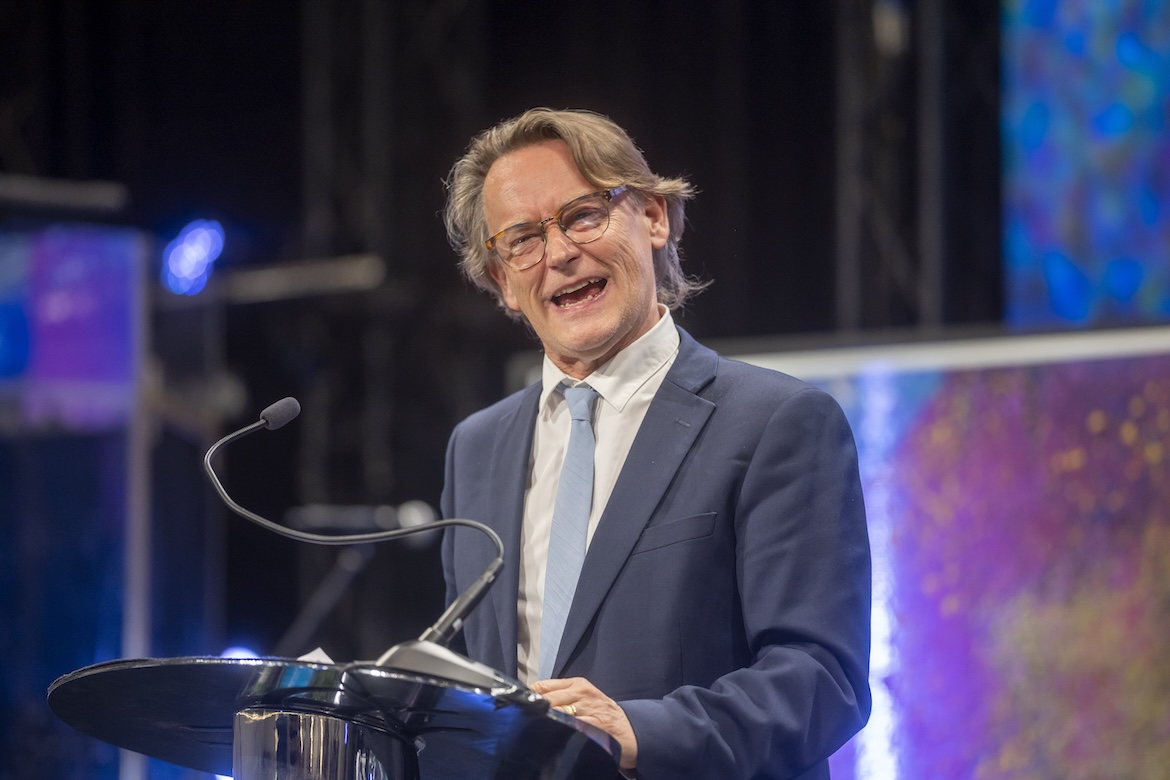
At the European Pentecostal Asia Summit (EAPS) earlier this year in May, Professor Ulrik Josefsson’s paper on “Pentecostals in Societal Engagement: A Theology for Incarnational Transformation” expounded on many of the lessons and reflections gained over decades of ministry.
Professor Josefsson holds a PhD in theology and an MA from Lund University. His diverse background spans pedagogy, theology, and pastoral leadership, and he has worked in both pastoral and missionary service within the Swedish Pentecostal movement.
In this interview, Professor Ulrik reflects on his surprising journey into academia, the theology behind Pentecostal social engagement, and the importance of integrating one’s heart, mind, and hands in the life of the Church.
CITY NEWS: You’ve worn many hats—pastor, missionary, professor, and now President of Academy for Leadership and Theology in Sweden. How did you first sense God leading you into ministry and theology? Growing up, did you ever imagine becoming a theological professor?
PROF ULRIK JOSEFSSON: Oh no, not at all. In the Swedish Pentecostal movement, higher education was actually rejected for many years. When I felt called to ministry, it was to be an evangelist or a pastor—education wasn’t part of the picture.
I started as an evangelist, then became a pastor—completely without formal education, like most of my friends at the time. But over time, I felt the need for more tools. I was working with public schools and realised they expected me to speak on topics I wasn’t fully equipped to address. So I went to the local university—just for one year—to reach the same level of religious education as the school teachers. One year then turned into another and another.
It wasn’t a strategic career plan, but it unfolded step by step. If you’d told 20-year-old Ulrik that one day he’d be a professor leading a university, he would’ve laughed because it would be so unlikely!
And look where God has brought you! With so many challenges the Church faces today, what is it about social engagement—especially from a Pentecostal perspective—that really grabs your heart?
There are a few layers to that. First, I think caring is embedded in our human nature. If you see someone fall on the street, you immediately want to reach out and help. That’s just our natural reaction as humans.
At another layer —Sweden is a Christian country, but it’s very secularised. Christianity feels increasingly irrelevant. So showing the Gospel via demonstrating practical love, not just talking about it, becomes vital. It’s not about being strategic—it’s about being the Church and showing love in a real, practical way.
And finally, there’s a theological layer. I believe Jesus died for the whole person—body and soul. Salvation isn’t just about saving souls; it’s about redemption for the whole person. When the Church engages society, we become a voice of the new creation and part of the greater redemption story —helping to build and embody a different kind of society. And that is why social engagement is so critical.
That’s so true. Did you engage in missionary work whilst in Bolivia?
I was a missionary kid. My parents moved to Bolivia when I was 14, so I spent a couple of my teenage years there. I was not a missionary then, but we were really engaged in the church, and funnily enough, even learned to play Bolivian folk music—which was quite special, as foreigners.
Later in life, my actual mission work has mainly been in Africa. My local church has been involved in Ethiopia for many years. Now, I work across East Africa supporting churches connected to the Scandinavian Pentecostal mission. These are African, indigenous free churches with about 25 million members altogether. I serve as an educational and theological consultant, helping them build and strengthen theological training institutions.
In your paper, you talk about the “Pentecostal principle”—this idea of being a transforming presence everywhere we go. How can Christians practice that in the climate of increasing secularisation?
I used that terminology based on the book The Pentecostal Principle by Prof Dr Nimi Wariboko, which highlights that a Pentecostal person and church is meant to be tangibly transformative in personal life, church life, and society.
For Pentecostals, faith involves a dynamic interplay between three fields ie, theology, affection (or emotion), and praxis (or practice). These elements don’t follow a strict order. Sometimes theology impacts our emotions, which then leads to praxis. Other times our praxis comes first, and then we reflect theologically about it. Yet other times, we start with having a deep conviction or feeling, a call from God, and then it affects our theology and praxis.
The interplay between these three fields ie, doctrinal theology, affection and praxis is the heart of Pentecostal Christianity. It is what makes Pentecostal social engagement so effective. A researcher named Dina Freeman studied this in Ethiopia and found Pentecostal initiatives had more sustainability than NGOs, because their work was rooted in theology and communal life.
I call it incarnational transformation. The Gospel lands in our hearts, we live it out, and through that, God’s presence is manifested in society.
Practical theology can sound a bit academic and challenging to grasp—but for you personally, what makes it come alive?
Great question. Practical theology is really just asking: What are we doing in church—and why? In academic terms, it is called liturgy.
Take your church here at City Harvest. It’s my first time here at your church, but I have observed three things about your liturgy. First, everyone prays—intensely. Then, there’s this unspoken rhythm between pastor and congregation where no one says, “Stop praying,” yet everyone ends at the same time. That’s part of your liturgy, where there’s a very sensitive dimension between the leader and the congregation.
Secondly, there’s the communal response: “God is good,” and everyone replies “All the time”—that’s liturgy. It is a repeated ongoing confession in your church, forming a culture that helps the members interpret life through that lens that God is good all the time, even when hard things are happening.
Thirdly, you often end with the leader encouraging the church to give God a big hand. That’s a liturgical element right there. For me, I see it as a way of including the whole church in the liturgical that forms a community. It becomes a common interaction between the whole church.
So practical theology is about observing and reflecting on what these actions mean theologically and communally. It’s not just theory—it’s grounded in real life.
Your observations are very accurate!
Yes, this is all practical theology, it’s not as complicated as you might think. One more reflection I’d like to share: listening to prayer is very interesting material for a practical theologian. Prayer is a spontaneous expression of your theology.
In the Swedish Pentecostal tradition, prayers—even those expressing deep needs—are often framed with gratitude. For example, someone praying for healing might say, “Dear Jesus, I thank you for your power to heal,” even in the midst of suffering. This thankful posture reflects a deeply ingrained theological attitude, and reveals something deep about the community’s theology and view of God.
Okay, time for a fun one—behind all your leadership and academic work, who is Ulrik at home? Tell us about your family!
I’m married to Carina—we met as kids at mission school in Bolivia. We weren’t a couple then (she was 10, I was 14), but we reconnected later and got married. We’ve been together 34 years. We have three sons: Amos (30), Isak (28), and Elis (24). Amos is married to a Swedish-American and they’re missionaries in Thailand. Elis is currently in Rwanda studying peace and reconciliation in Rwanda. And—we’re grandparents now! Our grandson’s name is Levi.
At home, I love cooking. It’s how I relax. During COVID, Karina and I also started hiking and visiting Sweden’s 30 national parks. We’ve now been to all of them!
What do the next five to ten years look like for you?
I just turned 60. In Sweden, retirement is around 65, so I expect five to seven more years in formal leadership. I’m currently president of ALT, still teaching and doing some research. But over time, I’d like to shift more toward supporting theological education in Africa. There’s such a great need. Eventually, I hope to slow down a little… and walk more forests!
I love that! Final reflections—what’s one thing you’ll take away from your time at this Summit?
This has been amazing. I already knew the European scholars here, but experiencing this summit—in a setting that deeply respects academic thought, yet overflowing with passionate worship and mission—was special.
In Europe, we’ve often separated faith and academia too sharply. But that separation is truly against the nature of creation. God created us with hands and bones, but also with heads and thoughts, as well as hearts and passion. The integration of thoughtful academic reflection with a passionate worship and a practical expression of the church is what I have seen here, and that is impressive, and something that I will bring with me.
Thank you so much, Professor Ulrik. We hope to see you back again!
I’d love that. Thank you for having me!
